GEOTECHNICAL EVALUATION OF LANDSLIDE THROUGH A BACK ANALYSIS APPROACH ON THE DISPOSAL AREA SLOPE AT PIT 'X', TANJUNG ENIM, SOUTH SUMATRA
DOI:
https://doi.org/10.30556/imj.Vol28.No2.2025.1623Keywords:
disposal area, back analysis, Slope stability analysis, safety factor, 3D-limit equilibrium methodAbstract
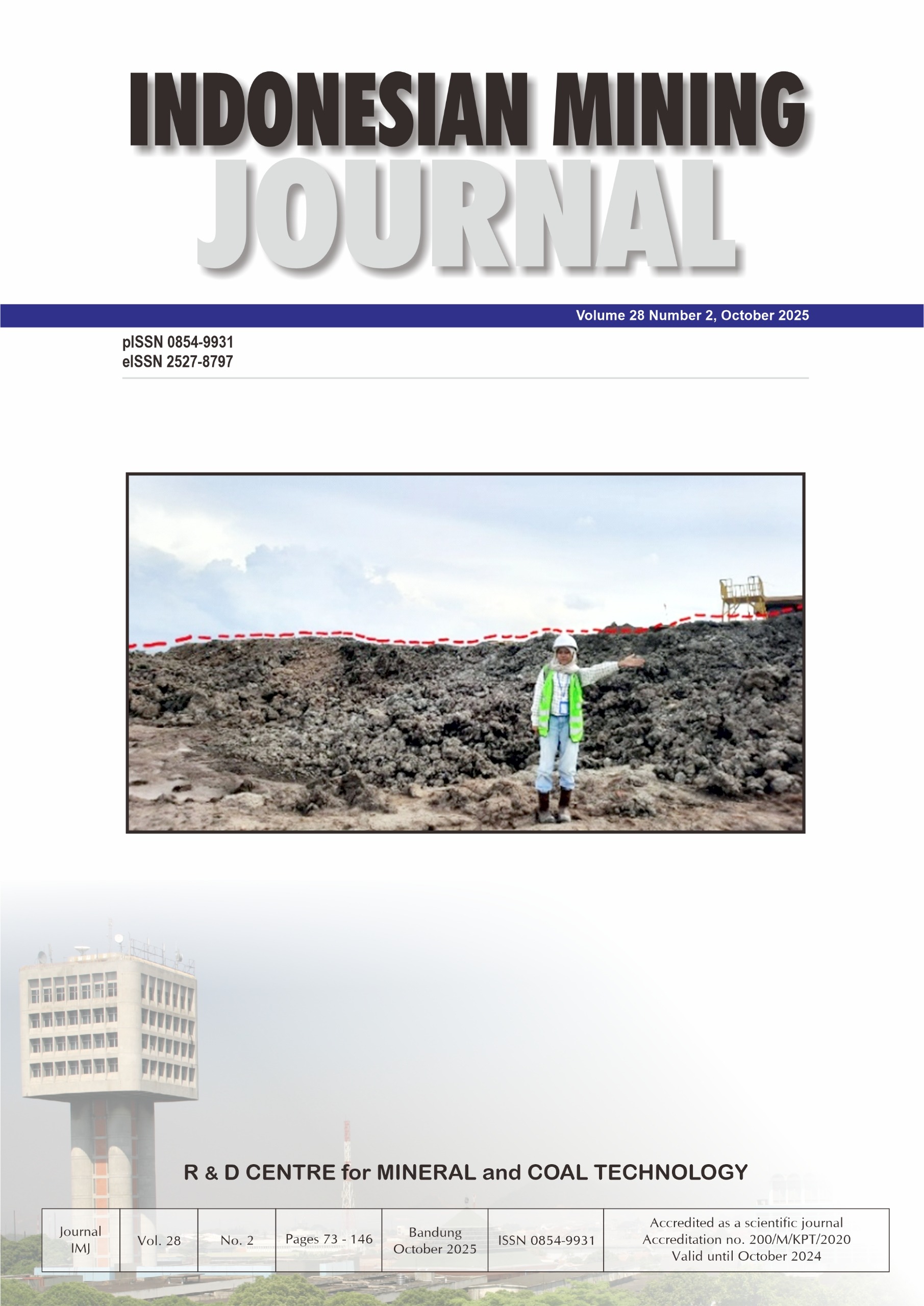
In open pit mining, the main activities include excavating the material from its original state and transporting it to the disposal area or stockpile, which forms an embankment. Slope stability in the disposal area should be monitored regularly to prevent losses caused by landslides. If a landslide occurs, it is important to identify the cause as a basis for recommending new slope design and implementing appropriate engineering measures to prevent future landslide occurrences. This study was conducted on a slope that had experienced a landslide in the Pit 'X' disposal area, Tanjung Enim, South Sumatra. This study aims to analyze the cause of the landslide by using a back analysis approach. Slope stability analysis was conducted using the Morgenstern-Price boundary equilibrium method, with failure probabilities calculated using Slide 2 software. Input data consisted of cohesion, internal friction angles, and unit weight of slope material. Based on the slope stability analysis, landslides occurred on slopes with a safety factor of 1 and a 40% probability of failure. This was caused by a 67.43% decrease in cohesion caused by the water-saturated condition of the clay material and the influence of the steep slope geometry. The proposed engineering solutions include slope grading, which increases the factor of safety by 30.31%, and the addition of counterweights, which further increases the factor of safety by 32.10%.
References
Adriansyah, Y., Saprana, R.D., Sophian, I. and Khoirullah, N. (2021) ‘The application of failure method probability for analyzing in pit dump stability at West Block “X” pit PT Berau Coal - East Kalimantan’, Indonesian Mining Journal, 24(2), pp. 71–83. Available at: https://doi.org/10.30556/imj.Vol24.No2.2021.1217.
Arif, I. (2021) Geoteknik tambang. Jakarta: PT. Gramedia Pustaka Utama.
Astriani, D.U., Muslim, D., Mulyo, A. and Pramudyo, T. (2022) ‘Potensi tanah mengembang berdasarkan kadar lempung di Kabupaten Bekasi, Jawa Barat’, Jurnal Geominerba, 7(2), pp. 133–141. Available at: https://doi.org/10.58522/ppsdm22.v7i2.103.
Cao, C., Feng, J. and Tao, Z. (2020) ‘Start-up mechanism and dynamic process of landslides in the full high waste dump’, Water, 12(9), p. 2543. Available at: https://doi.org/10.3390/w12092543.
Chen, Z., Xie, C., Xiong, G., Shen, J. and Yang, B. (2023) ‘Using the Morgenstern–Price method and cloud theory to invert the shear strength index of tailings dams and reveal the coupling deformation and failure law under extreme rainfall’, Sustainability, 15(7), p. 6106. Available at: https://doi.org/10.3390/su15076106.
Das, B.M. and Sobhan, K. (2014) Principles of geotechnical engineering. 8th Ed. Stamford: Cengage Learning.
Ering, P. and Babu, G.L.S. (2016) ‘Probabilistic back analysis of rainfall induced landslide‐ A case study of Malin landslide, India’, Engineering Geology, 208, pp. 154–164. Available at: https://doi.org/10.1016/j.enggeo.2016.05.002.
Gafoer, S., Cobrie, T. and Purnomo, J. (1986) Peta geologi lembar Lahat, Sumatera Selatan. Bandung.
Haris, V.T., Lubis, F. and Winayati, W. (2018) ‘Nilai kohesi dan sudut geser tanah pada akses Gerbang Selatan Universitas Lancang Kuning’, SIKLUS: Jurnal Teknik Sipil, 4(2), pp. 123–130. Available at: https://doi.org/10.31849/siklus.v4i2.1143.
Imam, P.S., Hariyanto and Agung, C.T. (2011) ‘Studi kasus analisa kestabilan lereng disposaldi daerah karuh, Kec. Kintap, Kab. Tanah Laut, Kalimantan Selatan’, in Seminar Nasional ke-6 Tahun 2011 : Rekayasa Teknologi Industri dan Informasi. Yogyakarta: Sekolah Tinggi Teknologi Nasional, pp. 381–387.
Krahn, J. (2003) ‘The 2001 R.M. Hardy Lecture: The limits of limit equilibrium analyses’, Canadian Geotechnical Journal, 40(3), pp. 643–660. Available at: https://doi.org/10.1139/t03-024.
Metriani, R., Anaperta, Y.M. and Saldy, T.G. (2019) ‘Analisis balik kestabilan lereng dengan menggunakan metode Bishop yang disederhanakan pada Front II Existing Tambang Quarry PT. Semen Padang, Sumatera Barat’, Bina Tambang, 4(4), pp. 49–58.
Nugroho, E., Firmansyah, Y.C., Hanafi and Hakim, L. (2022) ‘Perencanaan counterweight untuk mitigasi pasca longsor di side wall Pit C2, Sambarata Mine Operation, PT Berau Coal’, in Prosiding Optimalisasi, Konservasi dan Hilirisasi Mineral dan Batubara untuk Menunjang Ketahanan Energi dan Industri Nasional. Jakarta: PERHAPI, pp. 183–194.
Paliwal, M., Goswami, H., Ray, A., Bharati, A.K., Rai, R. and Khandelwal, M. (2022) ‘Stability prediction of residual soil and rock slope using artificial neural network’, Advances in Civil Engineering. Edited by H. Hasanzadehshooiili, 2022(1). Available at: https://doi.org/10.1155/2022/4121193.
Rizaldi and Heriyadi, B. (2020) ‘Analisis balik kestabilan lereng dengan menggunakan metode Bishop yang disederhanakan pada area Blok Bukit Tambun PT. Cahaya Bumi Perdana, Kota Sawahlunto’, Bina Tambang, 5(4), pp. 57–67.
Sarah, D., Zulfahmi, Z., Putra, M.H.Z., Madiutomo, N., Gunawan, G., Sumaryadi, S. and Ahmid, D.A. (2024) ‘Back analysis of rainfall-induced landslide in Cimanggung District of Sumedang Regency in West Java using deterministic and probabilistic analyses’, Geosciences, 14(12), p. 347. Available at: https://doi.org/10.3390/geosciences14120347.
Seed, H.B., Woodward, R.J. and Lundgren, R. (1963) ‘Prediction of swelling potential for compacted clays’, Transactions of the American Society of Civil Engineers, 128(1), pp. 1443–1477. Available at: https://doi.org/10.1061/TACEAT.0008724.
Siswanda, F.M. and Riswandi, H. (2024) ‘Analisis kestabilan lereng berdasarkan Mohr-Coulomb dan Generalized Hoek-Brown pada tambang terbuka batubara, Desa Tegalrejo dan sekitarnya, Kabupaten Muara Enim, Provinsi Sumatra Selatan’, Jurnal Ilmiah Geologi Pangea, 11(1), pp. 79–93.
Takwin, G.A., Turangan, A.E. and Rondonuwu, S.G. (2017) ‘Analisis kestabilan lereng metode Morgenstern-Price (Studi kasus : Diamond Hill Citraland)’, TEKNO, 15(67), pp. 66–76.
Tchakalova, B. and Ivanov, P. (2022) ‘Correlation between effective cohesion and plasticity index of clay’, Geologica Balcanica, 51(3), pp. 45–49. Available at: https://doi.org/10.52321/GeolBalc.51.3.45.
Umam, K., Nugroho, S.A. and Wibisono, G. (2017) ‘Pengaruh gradasi pasir dan kadar lempung terhadap kuat geser tanah’, Jom FTEKNIK 4, 4(1), pp. 1–8.
Utama, H., Yuliet, R. and Andriani (2006) Uji perilaku mengembang pada tanah lempung Aie Pacah dengan metoda free swell test. Universitas Andalas Padang.
Widiaswara, A., Afriani, L., Purwadi, O.T. and Setyanto (2018) ‘Pengaruh stabilitas lereng terhadap nilai kohesi, sudut geser dalam tanah dan perubahan tingkat ketinggian muka air tanah’, in Prosiding Semnas SINTA FT UNILA. Bandar Lampung: Fakultas Teknik Universitas Lampung, pp. 230–234.
Wyllie, D.C. and Mah, C.W. (2004) Rock slope engineering: Civil and mining. 4th edn. London and New York: Spon Press.
Yang, R., Xu, Z., Chai, J., Cao, C., Ren, J. and Chang, X. (2024) ‘Effect of the spatial changes in engineering properties on municipal solid waste landfill slope stability’, Bulletin of Engineering Geology and the Environment, 83(11), p. 462. Available at: https://doi.org/10.1007/s10064-024-03952-y.
Zhang, Y. (2015) ‘Stability and run-out analysis of earthquake-induced landslides’, in A. Moustafa (ed.) Earthquake Engineering - From Engineering Seismology to Optimal Seismic Design of Engineering Structures. InTech. Available at: https://doi.org/10.5772/59439.
Downloads
Published
Issue
Section
License

This work is licensed under a Creative Commons Attribution-NonCommercial 4.0 International License.
Indonesian Mining Journal provides immediate open access to its content on the principle that making research freely available to the public to supports a greater global exchange of knowledge.

This work is licensed under a Creative Commons Attribution-NonCommercial 4.0 International License.